
EMS Cost Calculation Software with Digital Twin and True Costing

Say goodbye to gut feeling and error-prone spreadsheets. PCBoffer integrates your machine park directly into quoting and calculates setup and production times down to the second. The same order yields the same price, no matter who calculates it or when.

pcboffer: sourcing and costing report44 lines sourced live
Quantity tier costingmaterial per board
1 Stk4.343,68 €4.343,68 €
10 Stk4.827,22 €482,72 €
50 Stk6.718,77 €134,38 €
100 Stk8.903,39 €89,03 €
500 Stk26.517,72 €53,04 €
Routing, machines and times
OperationSetupUnit time
Solder paste print side 1Stencil printer5,0 min0 s
SMD placement side 1Manual placement, lot size 110,0 min43,9 min
Reflow soldering side 1Reflow oven5,0 min9,9 min
Final release and test recordsFinal inspection–16 s
Line detail and sourcing path
C1, C26 · GRM21BR71H224KA01L
classified as capacitor → customer MPN confirmed → from your own stock, four different lots according to your stock master
0.0045 € per piece effective at 500 boards, 1,887 pieces in your stock
Supply chain and BOM health
91 %available from distributor stock right away, 20 of 22 lines
1line at end of life, check before series start
82 %BOM health score across all 44 lines
76 %of the material cost at 500 pieces sits on 5 of 34 parts

The Problem: Costing with Excel and Rough Assumptions

Traditional quote tools stop at material purchasing. Setup times, line performance, bottlenecks, and real cycle times are often estimated with flat averages. The result is uncertain pricing, unstable margins, and heavy manual coordination between sourcing and shopfloor. On top of that, costing in many companies rests on one or two experienced people: when they are on holiday or leave the company, their experience goes with them, and the same order is priced differently the next time around.

How It Works

How It Works

01

Upload BOM & PCB Data

BOM and CAD data are ingested in a structured flow.

02

Digital Twin Analyzes Setup

Machine park, line logic, and hourly rates are modeled.

03

Machine Simulation Calculates Times

Physical models simulate real process and setup times.

04

Accurate Manufacturing Cost & Quote

Transparent costing delivers reliable pricing and margins.
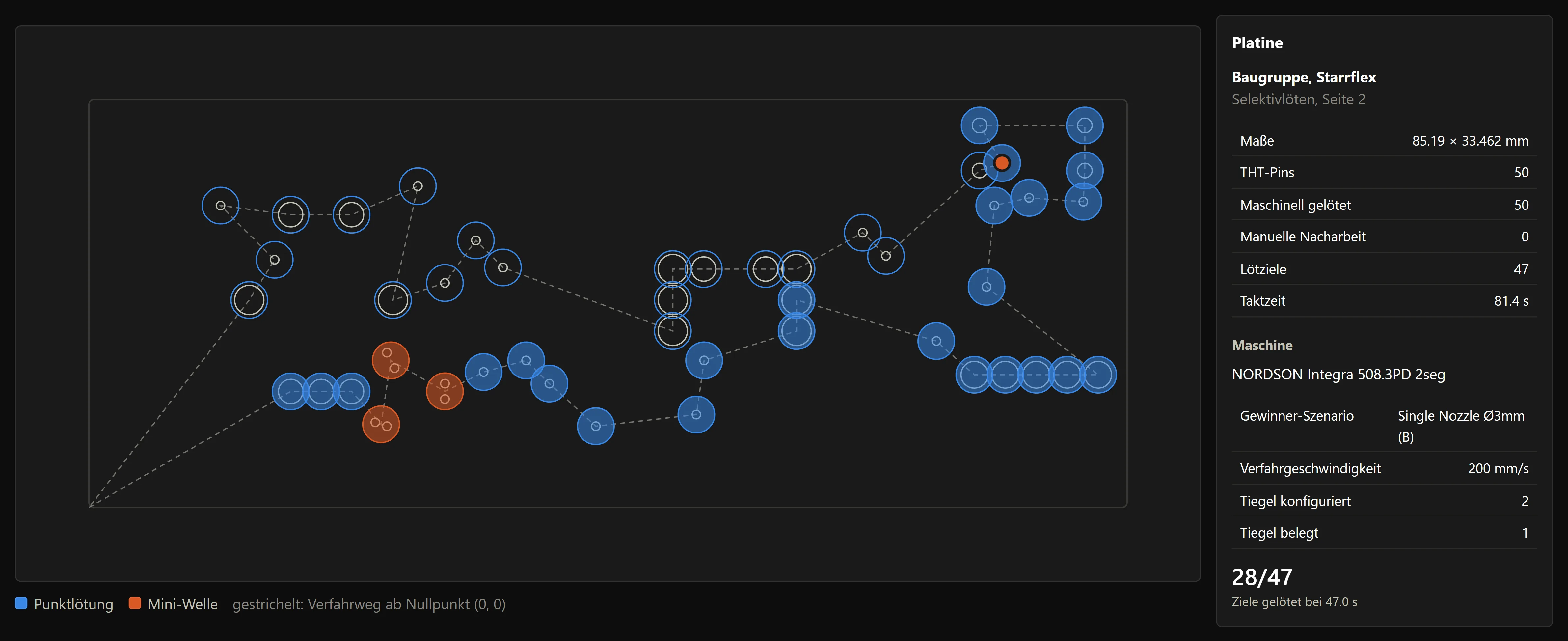
Simulated nozzle path of a selective soldering machine over an assembly, with 47 solder targets and the cycle time derived from them
An example from the machine simulation: the nozzle path across 47 solder targets is optimised, and the cycle time of 81.4 seconds per assembly falls out of it. The same calculation supplies the times for placement, reflow and final inspection.
Core Features

Features for Modern EMS Manufacturers

Digital Twin for EMS

Your complete machine park is mapped in the system and integrated directly into quoting.

SMD Line & Machine Simulation

Dedicated algorithms calculate CPH and travel paths based on your real equipment (e.g., Siplace, Fuji, Ersa).

True Costing & Bottleneck Detection

The full line is simulated as one system. Real cycle time is derived from the slowest process.

Dynamic Manufacturing Costs

Costs are calculated transparently from process time, machine hourly rates, labor demand, and labor costs.

Setup Cost Optimization

Setup times flow directly into lot-size costing and make setup cost effects visible.

Automatic Manual vs Machine Decision

For small batches with high setup overhead, the system automatically selects the more cost-efficient assembly path.

By the Numbers

KPI Visibility into Your Manufacturing Economics

92%
Costing Accuracy
10x
Faster Quoting Phase
31h
Time Saved / 10 Quotes
14%
Higher Margin via True Costing

Free: PCB panelisation calculator

How many boards fit on one panel, how large the panel becomes and how much area stays unused. No sign-up, computed in the browser, with the same physics the costing uses.

Calculate a panel

Frequently asked questions

How is manufacturing cost calculated from ODB++ or Gerber data?
PCBoffer reads the fabrication data directly: layer stack, copper weight, dielectric build-up, drill and via geometry including laser vias, routing and panelization. From that geometry it derives the process steps a board actually needs, and prices them against the work centers of your own plant. Nothing is typed in by hand that the CAD data already states.
What are NRE costs in PCB assembly?
Non-recurring engineering costs: the one-off costs of preparing a product for production rather than the per-piece cost: stencil, programming and setup of the placement lines, feeder setup, first-article inspection, test fixtures and process documentation. They dominate the price of a small batch and disappear into the noise on a large one, which is why they have to be shown separately per lot size instead of being averaged into a unit price.
How do I get assembly cost from a pick-and-place file instead of a flat surcharge per component?
Placement time is derived per component from the pick-and-place file, and selective soldering time from where the joints sit on the assembly. Wave and reflow times come from the conveyor and work-center model. All of it is parameterised with the machine park you actually own, not with generic industry averages, so a fine-pitch part on a slow line and a passive on a fast one no longer cost the same.
Can the cost model be calibrated against our own plant?
Yes. On-site calibration against the real plant is available with guaranteed accuracy. Beyond that, machine data flowing back from the shop floor corrects the model continuously, so the next calculation is based on what the plant really achieved rather than on assumptions that drift.
Does PCBoffer optimise PCB panelisation as well?
Yes, for the case that actually comes up in an EMS shop: an assembly is too small to run on the line on its own, so it is combined into a production panel. PCBoffer works through the possible arrangements and selects first by the number of runs, because printing, oven and handling are paid per run. On a reference board this makes the same order 26.4 % cheaper, purely through the choice of panel. How large the panel may become is calculated rather than configured: 0.5 mm of sag is allowed, because beyond that the nozzle misses the pad and the stencil no longer seals, and the copper counts towards the stiffness. Separating the panel itself, scoring or routing, is done by the PCB fabricator and is therefore not part of this calculation.Work out your own panel: the free panelisation calculator
What happens when a figure is not reliable?
It is flagged rather than used silently. For every value, the costing carries where it came from, what it affects and what PCBoffer suggests instead. Your work preparation corrects it by hand, decides on the suggestion, and only after that review does the quote go to the customer. For a part substitution this is an explicit approval step: the system proposes and gives its reasoning, a person approves or rejects. Every explanation also carries who it is meant for: markup logic, line capacity and machine and profile names stay in house, while the customer-facing explanations may travel with the quote. That is the guiding principle of the platform: automate where possible, keep every figure explainable, and let people decide where they are needed.
Live Demo

See PCBoffer in action: book a demo

30 minutes with founder Dr. Josip Strutz, on your own bill of materials: what PCBoffer calculates from it and where it takes work off your hands.

  • 30-minute live session via Google Meet
  • Tailored to your parts and your BOM
  • No commitment required
Book a demo · 30 min

Google Meet demo

Google Calendar